ここから本文です
TWO:

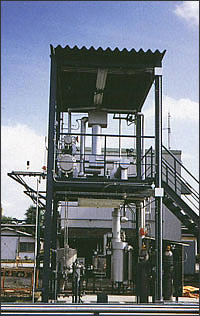
Membrane separation type solvent dehydration system

Great attention is recently being paid to global environmental issues, and it is now conceivable that companies will need to treat used solvents themselves. In consideration of this kind of social issue, we have developed a “membrane separation type solvent dehydration system,” which uses a polyimide membrane with superior dehydration properties developed by Ube Industries, Ltd. in combination with our own distillation and concentration technology that has resulted in solvents being more easily recovered.

THREE:"I am," he said. "See, I am familiar with her plot before she carried it out. As I told you before, the whole thing is founded on a novel of mine which has yet to be published. How she got the thing is a mystery. But she has got it. It could not possibly have been a coincidence."
  • 1Under the distillation system, even in case of azeotropic solvent compositions, this system which remove water vapor by the polyimide membrane will easily dehydrate.
  • 2In comparison with the distillation system, it significantly saves on use of steam.
  • 3Dehydration can be performed through merely supplying evaporated vapor to the membrane module and maintaining the differential pressure between the permeable side and the impermeable side.
  • 4Solvent purity of 99.9% or more can be achieved by carrying out dehydration with a polyimide membrane only.
  • 5The polyimide membrane has superior heat and solvent resistance. Therefore, the vapor permeation system reduces contamination of the membrane and thus extends its life.
THREE:"How did you know that?" Charlton asked.Id rather go down by the water and see if its cooler there, Sandy said, trying to catch Larrys eye. Since we got down out of the cool air its the hottest day this June.

The aromatic polyimide membrane is highly permeable to water vapor but less permeable to vapors of organic compounds such as alcohol etc.

THREE:The treatment of the passions by the Stoic school presents greater difficulties, due partly to their own vacillation, partly to the very indefinite nature of the feelings in question. It will be admitted that here also the claims of duty are supreme. To follow the promptings of fear or of anger, of pity or of love, without considering the ulterior consequences of our action, is, of course, wrong. For even if, in any particular instance, no harm comes of the concession, we cannot be sure that such will always be the case; and meanwhile the passion is23 strengthened by indulgence. And we have also to consider the bad effect produced on the character of those who, finding themselves the object of passion, learn to address themselves to it instead of to reason. Difficulties arise when we begin to consider how far education should aim at the systematic discouragement of strong emotion. Here the Stoics seem to have taken up a position not very consistent either with their appeals to Nature or with their teleological assumptions. Nothing strikes one as more unnatural than the complete absence of human feeling; and a believer in design might plausibly maintain that every emotion conduced to the preservation either of the individual or of the race. We find, however, that the Stoics, here as elsewhere reversing the Aristotelian method, would not admit the existence of a psychological distinction between reason and passion. According to their analysis, the emotions are so many different forms of judgment. Joy and sorrow are false opinions respecting good and evil in the present: desire and fear, false opinions respecting good and evil in the future.53 But, granting a righteous will to be the only good, and its absence the only evil, there can be no room for any of these feelings in the mind of a truly virtuous man, since his opinions on the subject of good are correct, and its possession depends entirely on himself. Everything else arises from an external necessity, to strive with which would be useless because it is inevitable, foolish because it is beneficent, and impious because it is supremely wise.
  • 1 Recovery of the detergent solvent Recovery of the cleaning solvent such as electronic parts industry, precision instrument industry.
  • 2Solvent recovery and the refinement Solvent recovery and the refinement such as chemical industry, an industry of medical supplies, food industry, the fermentation industry.
THREE:A principle in mechanics may be known, and even familiar to a learner, without being logically understood; it might even be said that both theory and practice may be learned without the power to connect and apply the two things. A person may, for example, understand the geometry of tooth gearing and how to lay out teeth of the proper form for various kinds of wheels, how to proportion and arrange the spokes, rims, hubs, and so on; he may also understand the practical application of wheels as a means of varying or transmitting motion, but between this knowledge and a complete wheel lies a long train of intricate processes, such as pattern-making, moulding, casting, boring, and fitting. Farther on comes other conditions connected with the operation of wheels, such as adaptation, wear, noise, accidental strains, with many other things equally as important, as epicycloidal curves or other geometrical problems relating to wheels.

Acetone, ethanol, methyl ethyl ketone, butanol, isopropyl alcohol, ethyl acetate, methyl isobutyl ketone, others (including hexane and toluene).